Advertisements
The real examples of AI in education They show how technology is no longer a futuristic concept, but a transformative tool that redefines the way we teach and learn.
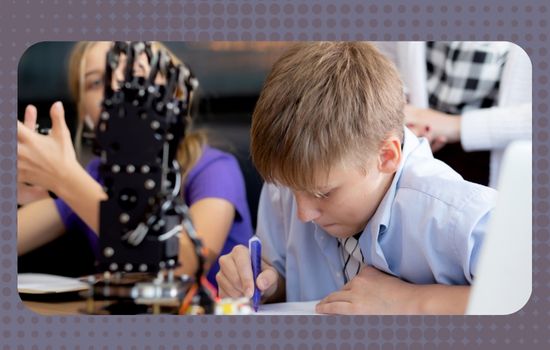
From algorithms that personalize learning pace to systems that predict dropout rates, artificial intelligence (AI) has begun to make a profound impact on the modern classroom.
But is education prepared for such rapid change?
Summary:
Advertisements
- What AI represents in the current educational context
- Real examples of AI applied to learning
- Impact on teaching and academic management
- Challenges and necessary precautions
- Future opportunities
- Frequently Asked Questions
The new era of education powered by AI
21st-century education is at a turning point.
The real examples of AI in education They are proof that technology not only assists teachers, but also expands the cognitive abilities of students of all ages.
According to UNESCO (2024), more than 60% of universities in Latin America They are already implementing artificial intelligence tools to improve academic management, analyze performance data, and create personalized learning experiences.
This phenomenon demonstrates an unstoppable trend: AI does not replace teachers, but rather supports them in making more precise and evidence-based pedagogical decisions.
The question is no longer whether AI should be used in classrooms, but as do so in an ethical, safe and efficient manner.
Real-life applications that transform learning
1. Adaptive study platforms
One of the real examples of AI in education More relevant are adaptive platforms, such as Smart Sparrow and Century Tech, which adjust the content according to each student's performance.
These systems analyze responses, reading time, and common errors to offer personalized exercises that reinforce areas for improvement.
Thanks to this technology, a student with math difficulties, for example, can receive visual or dynamic explanations that are different from those of a classmate who has a better command of the subject.
Thus, AI transforms traditional education—based on a single method—into a flexible, person-centered process.
2. Virtual educational assistants
Chatbots or virtual tutors are another of the real examples of AI in education that are gaining ground in Mexican and Latin American universities.
The National Autonomous University of Mexico (UNAM) implemented an intelligent assistant that answers questions about schedules, registration, and academic resources.
In its first year, the system served more than 200 thousand consultations students, freeing up an enormous administrative burden on human resources.
This type of conversational AI demonstrates that automation not only improves efficiency but also expands access to information, enabling continuous and personalized attention for each student.
The impact on teaching and academic management
The role of the teacher has also evolved. Instead of being the sole source of knowledge, they now act as a guide who uses AI to identify learning patterns or detect early problems.
For example, the system IBM Watson Education It has been used in the United States and Mexico to analyze student progress and recommend teaching strategies.
This not only improves the accuracy of educational assessments, but also helps teachers make informed decisions based on real data, not subjective perceptions.
Analogy: Artificial intelligence in education works like a smart mirror: it reflects the learning process, identifies invisible flaws, and shows possible paths to improving performance.
It does not teach by itself, but it illuminates paths that previously remained hidden.
Challenges and precautions regarding the expansion of AI
Despite the enthusiasm, the real examples of AI in education They also reveal ethical and technical dilemmas that must be addressed carefully.
1. Privacy and responsible use of data
Machine learning requires collecting vast amounts of information about student behavior.
Without clear transparency rules, data could be used for purposes other than educational purposes.
According to the Ibero-American Observatory of Digital Protection (2025), only the 47% of Latin American educational institutions have robust privacy protocols.
2. Digital divide
Not all schools have access to the same technological tools or infrastructure.
In rural areas of Mexico, many schools lack stable connectivity or adequate equipment to implement artificial intelligence programs.
This contrast can widen educational inequalities rather than narrow them.
3. Technological dependence
An additional risk is the over-reliance on AI.
When students blindly rely on automated recommendations, they may lose the initiative to research, debate, or question.
The balance between human thought and technological support remains essential for comprehensive training.
Table: Main benefits and challenges of AI in education
| Benefits | Challenges |
|---|---|
| Personalized and adaptive learning | Data privacy risks |
| Optimization of teaching work | Technological gap and inequality |
| Evidence-based evaluation | Over-reliance on algorithms |
| Improvement in educational accessibility | Need for teacher training |
| Administrative efficiency | Lack of ethical regulation |
This comparative view allows us to understand that the real examples of AI in education They are not absolute solutions, but rather tools whose value depends on the context and responsible management.
Read more: Most frequently asked questions in interviews
Concrete examples in Mexico and Latin America
Example 1: At Tecnológico de Monterrey, an AI project analyzes participation patterns in virtual classes and alerts tutors when a student shows signs of demotivation or poor performance.
Thanks to this system, the retention rate in online courses increased by 12% in 2024, according to the institutional report published that year.
Example 2: At the University of Buenos Aires, an AI application evaluates academic writing and provides real-time feedback on coherence and structure.
This has reduced common essay errors and improved students' writing skills without replacing the teacher.
Both cases illustrate how technology can be integrated without losing the human component of the educational process.
Opportunities for the educational future
The integration of the real examples of AI in education Not only does it improve current efficiency, but it also opens up new possibilities for the future:
- Smart assessments that detect understanding beyond the correct answers.
- Immersive virtual environments, where AI personalizes learning scenarios in real time.
- Research assistants, capable of suggesting sources, summaries or personalized hypotheses.
The challenge will be to balance innovation with ethics, ensuring that artificial intelligence complements—not replaces—human creativity.
Technology may offer precision, but empathy and critical thinking remain irreplaceable.
Conclusion
The real examples of AI in education They demonstrate that the future is already present in the classrooms.
From Mexico to other corners of Latin America, AI is driving a silent revolution that is redefining what it means to learn and teach.
However, the real value is not in the algorithm, but in the intention with which it is used.
A school that integrates AI without reflection risks mechanizing learning; one that adopts it with a pedagogical vision can transform entire generations.
Smart education is not about having the most technology, but about teaching how to use it consciously.
In the next decade, educational success will depend on the ability to balance innovation with humanity.
Read more: Artificial intelligence in the classroom: advantages and risks
Frequently Asked Questions (FAQ)
1. What role does AI play in today's education?
It facilitates personalized learning, optimizes teaching tasks, and improves academic management through the analysis of real-world data.
2. What risks does its use entail?
The main ones are the vulnerability of personal data, technological inequality, and the loss of critical thinking if not used in moderation.
3. Will AI replace teachers?
No. Its role is supportive, not substitutive. Teachers remain the indispensable mediator between knowledge and understanding.
4. How can it be applied ethically?
With transparency, teacher training, privacy policies, and clear pedagogical objectives.
5. What is the future of educational AI in Mexico?
Progressive expansion is expected, driven by improved digital infrastructure and institutional interest in educational innovation.